Protein Paradox Part 1: The Role of Mechanical Tension

Why Muscle Growth Needs More Than Protein
The Role of Mechanical Tension by SARAT ADARI MSc.,C.H.N.C
Key idea: protein supplies the building blocks, but resistance training gives the body a reason to use them for muscle repair and growth.

Why Muscle Growth Needs More Than Protein
Protein is often treated like the main hero of muscle building. People buy protein powders, track grams, plan post-workout shakes, and assume that eating enough protein automatically leads to bigger muscles. Protein matters, but it is only one part of the process.
Your body does not build new muscle just because extra amino acids are available. Muscle tissue is costly to maintain, so the body needs a clear reason to invest nutrients into it. That reason is mechanical tension.
Mechanical tension is the force created when a muscle works against resistance. It can come from dumbbells, machines, barbells, resistance bands, body weight exercises, or even heavy daily tasks. When the tension is high enough and repeated consistently, your muscles receive a biological message: "This tissue needs to become stronger."
That message is what helps turn dietary protein into actual muscle repair and growth. Without enough training stimulus, protein can still support health, enzymes, hormones, immune function, and tissue maintenance, but it will not be directed efficiently toward building bigger muscles.

Visual summary: training creates the signal, protein supports rebuilding, and recovery turns the stimulus into adaptation.
Protein Gives the Materials, Training Gives the Reason
Think of protein as construction material. Amino acids are like bricks, cement, and tools. But having materials on-site does not mean a building will appear. There must be a construction plan, workers, and a reason to build.
Resistance training provides that reason.
When you lift a challenging weight, your muscle fibers experience stress. This stress is not just a "burn" or tired feeling. It is a mechanical signal that travels from the whole muscle level down to the cellular level. The body senses that the current muscle structure is being challenged. Over time, it adapts by improving strength, coordination, and eventually muscle size.
This is why someone can eat plenty of protein but still fail to gain noticeable muscle if their training is too easy, inconsistent, or poorly structured. Protein supports growth, but mechanical tension directs growth.
What Actually Happens During a Rep?
Let's use a simple biceps curl as an example.
When you pick up a dumbbell and bend your elbow, your biceps contract to move the weight. Your bones act like levers, your joints create movement, and your tendons transfer force from muscle to bone. Inside the muscle, thousands of tiny fibers work together to create the movement.
At the deepest level, muscle contraction happens inside small units called sarcomeres. These contain two major protein filaments called actin and myosin. Myosin pulls on actin, creating shortening and force. This repeated pulling action is what allows your muscle to move a load.
When the weight is light and easy, the body does not need to recruit many muscle fibers. But when the load becomes challenging, especially near the end of a hard set, the nervous system calls in more powerful muscle fibers. These high-threshold fibers are important because they have strong growth potential.
In simple terms: the harder the muscle has to work, the louder the growth signal becomes.
The Nervous System Starts the Process
Muscle growth begins before the weight even moves. It starts with the brain.
Your brain sends an electrical command through the nervous system to the target muscle. This signal travels from the brain to the spinal cord and then to motor neurons that connect to muscle fibers. At the muscle, chemical messengers help trigger contraction.
The body does not activate every muscle fiber at once. It recruits fibers based on need. Easy tasks use smaller, more fatigue-resistant fibers. Harder tasks require larger, stronger fibers. This is known as the size principle of motor unit recruitment.
That is why effort matters.
You do not always need to lift maximum weight, but the set must become demanding enough for your body to recruit the fibers that can grow. This can happen through heavy loads, controlled reps, explosive effort, or training close to failure with good form.
Why the Lowering Phase Matters
Many people focus only on lifting the weight up. But the lowering phase, also called the eccentric phase, is extremely important for muscle development.
During the eccentric portion, the muscle lengthens while still under tension. For example, when you lower a dumbbell during a curl, your biceps are not resting. They are controlling the weight as it pulls the arm down.
This loaded stretch creates a powerful mechanical signal. It places tension on muscle fibers, connective structures, and internal proteins that help the cell sense strain. When done properly, controlled eccentrics can increase the quality of each rep without needing to rush or use heavier weight than you can handle.
Lift with intent. Lower with control.
Mechanical Tension Becomes a Cellular Signal
Muscle fibers are not passive ropes. They can sense force.
When a muscle is stretched and challenged under load, specialized structures inside and around the muscle cell detect the strain. This process is called mechanotransduction, which simply means converting physical force into a biological signal.
Once the cell senses enough tension, it activates pathways involved in muscle protein synthesis. One of the most discussed pathways is mTOR, a major regulator of growth and repair. When mTOR activity increases in the right context, the body becomes more likely to use amino acids for building and repairing muscle proteins.
This is where protein and training meet.
Training creates the demand. Protein supplies the raw materials. Recovery allows the rebuilding to happen.
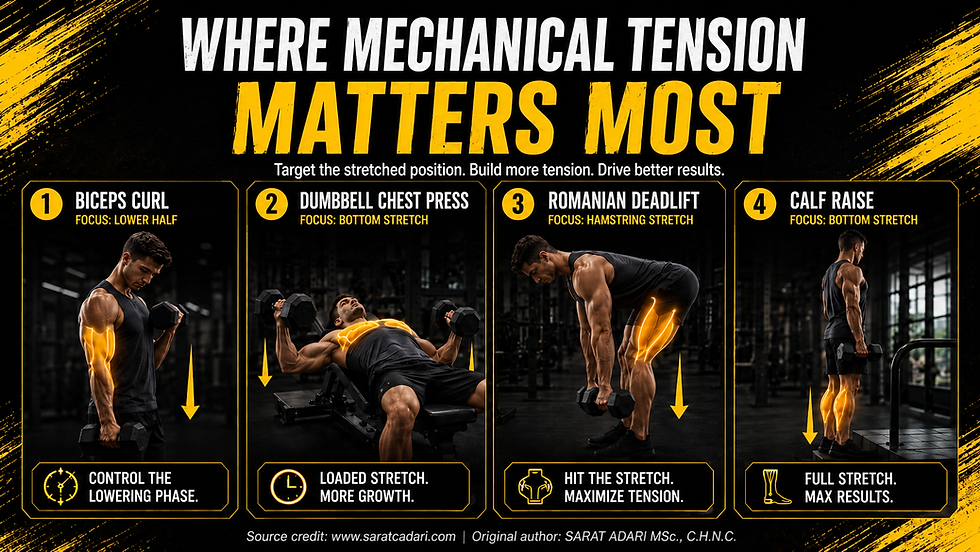
Mechanical tension is strongest when the target muscle is challenged through a controlled, useful range of motion.
Long-Length Training: Why Stretched Positions Can Be Powerful
One useful training concept is placing tension on a muscle when it is in a lengthened position.
Examples include:
For chest: the bottom part of a dumbbell press
For hamstrings: the stretched position of a Romanian deadlift
For calves: the bottom stretch of a calf raise
For biceps: the lower part of a curl when the arm is more extended
For triceps: overhead extensions where the long head is stretched
The reason this can be effective is that muscles often receive a strong growth stimulus when they are challenged under stretch. This does not mean you should bounce, force painful ranges, or use unsafe form. It means controlled tension in a stretched position can be valuable when used correctly.
Long-length partials, where you perform only the stretched portion of a movement, have become popular because they keep tension where the muscle is under high mechanical demand. They should not replace all full-range training, but they can be a useful tool for advanced hypertrophy work.
Progressive Overload: The Long-Term Growth Driver
One hard workout will not create major muscle growth. The body adapts through repeated signals over time.
Progressive overload means gradually increasing the challenge placed on your muscles. This can be done in several ways:
You can lift more weight.
You can perform more reps with the same weight.
You can improve control and range of motion.
You can add more quality sets.
You can slow down the lowering phase.
You can reduce momentum and make the target muscle work harder.
The goal is not to make every workout brutally difficult. The goal is to create a steady pattern of meaningful tension, recover from it, and return stronger.
For most people trying to build muscle, training each major muscle group around two times per week works well. Sets should usually be challenging, with a few reps left in reserve most of the time. Some sets can be taken very close to failure, especially on safer isolation exercises.
Good Form Keeps Tension Where It Belongs
Not all movement creates useful muscle tension.
If you swing a dumbbell curl with your hips and lower back, the biceps receive less targeted tension. If you shorten the range of motion too much, the muscle may miss important parts of the stimulus. If the weight is too heavy to control, other muscles and momentum take over.
Good form does not mean robotic movement. It means the exercise matches the goal.
For muscle growth, you want the target muscle to experience enough tension through a useful range of motion. The load should be challenging, but not so heavy that the movement becomes sloppy.
Quality reps usually beat ego lifting.

The core muscle-building principles: train smart, fuel well, recover deeply, and progress gradually.
Mind-Muscle Connection: Useful, But Not Magic
The mind-muscle connection means focusing attention on the muscle you are trying to train. For example, during a row, you may focus on driving the elbows back and squeezing the upper back instead of simply pulling the handle.
This can be helpful for bodybuilding-style training because it may improve activation of the target muscle. However, it has limits. If your goal is maximum strength or power, an external cue like "push the floor away" or "move the bar fast" may be more effective.
For hypertrophy, both approaches have value. Use internal focus for isolation exercises and muscles you struggle to feel. Use strong external performance cues for heavy compound lifts.
Nutrition: How to Support the Signal
Once training creates the demand, nutrition supports the rebuilding process.
Protein intake should be consistent across the day. Instead of eating very little protein all day and a huge amount around workouts, many people benefit from spreading protein into multiple meals. Each meal should ideally contain a quality protein source with enough essential amino acids to support muscle protein synthesis.
Good options include eggs, dairy, lean meats, fish, poultry, Greek yogurt, tofu, tempeh, legumes, and high-quality protein powders when convenient.
Carbohydrates can also support training performance. They help replenish glycogen, which is the stored carbohydrate used during intense exercise. Fats support hormones and overall health. A balanced diet usually works better than extreme restriction when the goal is muscle gain.
To build muscle, many people need a small calorie surplus. This does not mean overeating heavily. A modest increase in calories, paired with progressive training, can support lean mass gains while limiting unnecessary fat gain.
Supplements
Supplements can support a good plan, but they cannot replace training, food, sleep, and consistency.
Creatine monohydrate is one of the most researched supplements for strength and muscle performance. It helps support rapid energy production during hard sets, which may allow better training output over time.
Protein powder can be useful if you struggle to meet daily protein goals through food alone. Other supplements, such as Leucine, Citrulline, Beta Alanine, choline-based products, phosphatidic acid, electrolyte blends, or absorption-support formulas, can be used for performance or muscle growth.
The foundation is still simple: train hard, eat enough protein, supplement to plug the gaps, recover well, and repeat.
Recovery Is Where Growth Becomes Real
Training creates the signal, but recovery allows adaptation.
If you train hard but sleep poorly, eat too little, and stay constantly stressed, your results will suffer. Muscle growth requires energy, nutrients, hormonal balance, and time.
Sleep is especially important because recovery processes are active during rest. Most adults do best with around seven to nine hours per night. Stress management also matters because chronic stress can interfere with performance, appetite, recovery, and consistency.
Rest days are not wasted days. They are part of the growth process.
Common Mistakes That Reduce Muscle Growth
Many people work hard but limit their results because of avoidable mistakes.
One common mistake is chasing soreness instead of progression. Soreness can happen after a new workout, but it is not the best measure of muscle growth.
Another mistake is doing too much junk volume. More sets are not always better if the quality is low or recovery is poor. Some people also train too far from failure all the time. If every set is easy, the body may not receive a strong enough reason to adapt.
Others go to failure on every set, every workout, and eventually burn out. Smart training balances effort and recovery.
The best program is not the hardest one. It is the one you can perform consistently, progress gradually, and recover from.
A Practical Muscle-Building Blueprint
For someone trying to gain muscle naturally, the plan should be simple and repeatable.
Train three to five days per week, depending on schedule and recovery. Focus on compound lifts such as squats, presses, rows, deadlifts, pull-ups, and lunges. Add isolation exercises for muscles that need extra attention, such as biceps, triceps, side delts, calves, or hamstrings.
Use a mix of rep ranges. Heavy sets of five to eight reps can build strength and recruit powerful fibers. Moderate sets of eight to twelve reps are excellent for hypertrophy. Higher reps can also work well, especially when taken close to failure with controlled form.
Prioritize full range of motion when possible. Include controlled eccentrics. Use stretched-position work carefully. Track performance so you know whether you are improving.
Eat enough protein daily. Support training with enough total calories. Sleep well. Take progress photos, body measurements, and strength notes instead of relying only on scale weight.
Conclusion: Protein Builds Best When Tension Leads
Muscle growth is not just a nutrition problem. It is a signal problem.
Protein provides the building blocks, but mechanical tension tells the body where those building blocks are needed. A challenging rep sends a message through the nervous system, muscle fibers, and cellular growth pathways. Repeated over weeks and months, that message becomes adaptation.
The most effective muscle-building approach combines resistance training, progressive overload, proper protein intake, enough calories, and recovery. When these pieces work together, your body has both the reason and the resources to build new muscle.
So the next time you think about protein, also think about the training signal behind it. A shake can support the process, but the real instruction begins when the muscle has to work.
📢 A Note on "Living Science"
Science is not a static destination; it is a moving target. While the principles of Turnover, Signaling, and Tension are grounded in decades of metabolic research, new peer-reviewed data emerges every day.
I am committed to accuracy. If you are a researcher, clinician, or dedicated student of physiology and you find a piece of data here that does not align with the latest high-quality evidence, please reach out. I welcome civil, evidence-based corrections. My goal is to keep this resource as the most accurate "No-Nonsense" guide to protein on the internet. Let’s get better together.
*Disclaimer:
The information provided in this blog is for educational and informational purposes only and should not be construed as medical advice. While every effort is made to ensure accuracy, the content is not intended to replace professional medical consultation, diagnosis, or treatment. Always seek the guidance of a qualified healthcare provider with any questions regarding your health, medical conditions, or treatment options.
The author is not responsible for any health consequences that may result from following the information provided. Any lifestyle, dietary, or medical decisions should be made in consultation with a licensed medical professional.
If you have a medical emergency, please contact a healthcare provider or call emergency services immediately.


Comments